2 Old Cuban US Tech Execs Discuss AI Adoption [Video] Part 3
A key paradox in today’s AI landscape and the enterprise.
Editor’s note: This is part 3 of a series on AI. Please find Part 1: Two Hispanic Cuban- American Technologists Talk AI [Video] and Part 2: From AI Hype to Reality: Building the Zero-Latency [Video] Part 2

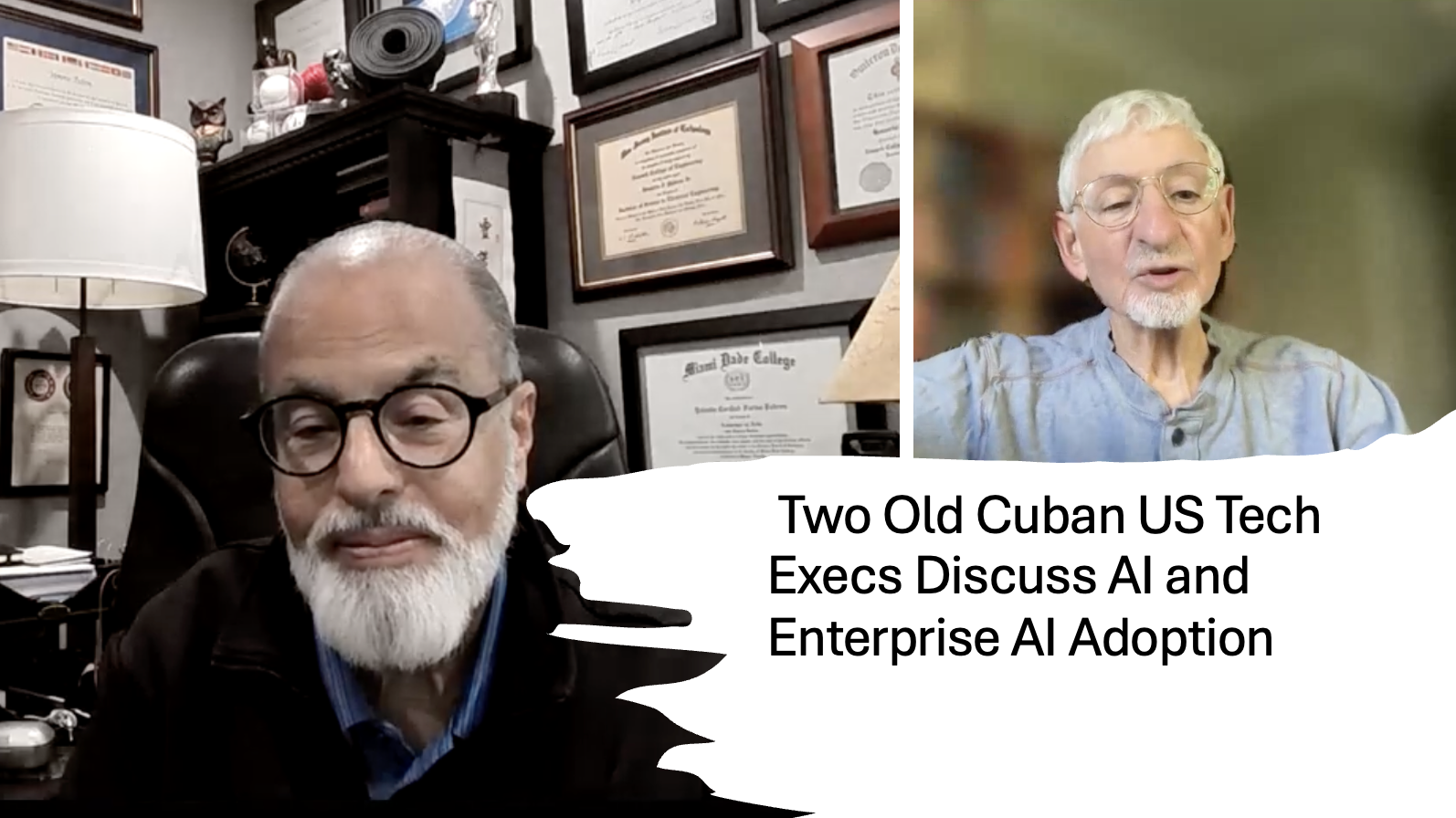
“In the third installment of their candid video series, Two Old Cuban US Tech Execs Discuss AI and Enterprise AI Adoption, Irving Wladawsky-Berger, Research Affiliate at MIT’s Sloan School of Management, Fellow of MIT’s Initiative on the Digital Economy, and a key architect of IBM’s internet and e-business strategy during his 37-year career at the company, joins Honorio Padron, founder of ExperienceBypass.com and author of the forthcoming book Building The Zero-Latency Intelligent Enterprise, for an unscripted conversation about the real state of AI, and its adoption in corporate America. Together, they explore why AI investments continue to underdeliver despite the hype, why the next generation of business leaders faces the same institutional resistance to new technology that every generation before them did, and what it actually takes to make AI work at enterprise scale. The conversation is grounded in Wladawsky-Berger’s broad perspective on technology adoption cycles and Padron’s long-term CIO/CTO career and current active field deployments with organizations ranging from a $6B industrial firm to a $100M manufacturer.”
This discussion centers on a key paradox in today’s AI landscape.
Despite rapid advances in AI capabilities and widespread experimentation, most organizations are still struggling to translate these innovations into sustained enterprise value. Drawing on your combined decades of experience, you and Padron explore the gap between individual productivity gains from AI tools and the much harder challenge of scaling AI across complex enterprises. The conversation highlights persistent structural barriers—fragmented data architectures, siloed operating models, governance gaps, and concerns around reliability and security—that prevent AI from delivering transformative impact at scale.
A central theme of the podcast is that meaningful AI-driven advantage will not come from isolated use cases or better models alone, but from rethinking how organizations operate. Padron introduces the idea of the “Zero Latency Intelligent Enterprise,” emphasizing the need for integrated, cross-functional decision-making systems that enable faster, coordinated actions across the business. This requires not just new technology, but redesigned governance, clearer accountability, and stronger alignment among senior leadership—particularly an evolving role for the CIO and other executives in orchestrating enterprise-wide transformation.
Overall, the conversation offers a grounded, strategic perspective: the real challenge of AI is no longer technical feasibility but organizational readiness. Companies that succeed will be those that move beyond experimentation and hype, and instead redesign their processes, data flows, and decision structures to fully embed AI into how work gets done.
Related content:
Part 1: Two Hispanic Cuban- American Technologists Talk AI [Video]
Part 2: From AI Hype to Reality: Building the Zero-Latency [Video] Part 2
How AI Is Changing the Job Market—and Why Latinos Must Stay Ahead
AI & Us: The New Rules of Work and Life. Risk & Readiness Part 3