Evolution of Sound Healing- Ancient Temples to Corp Conferences
How companies are exploring new ways to support the mental and emotional well-being of their teams.
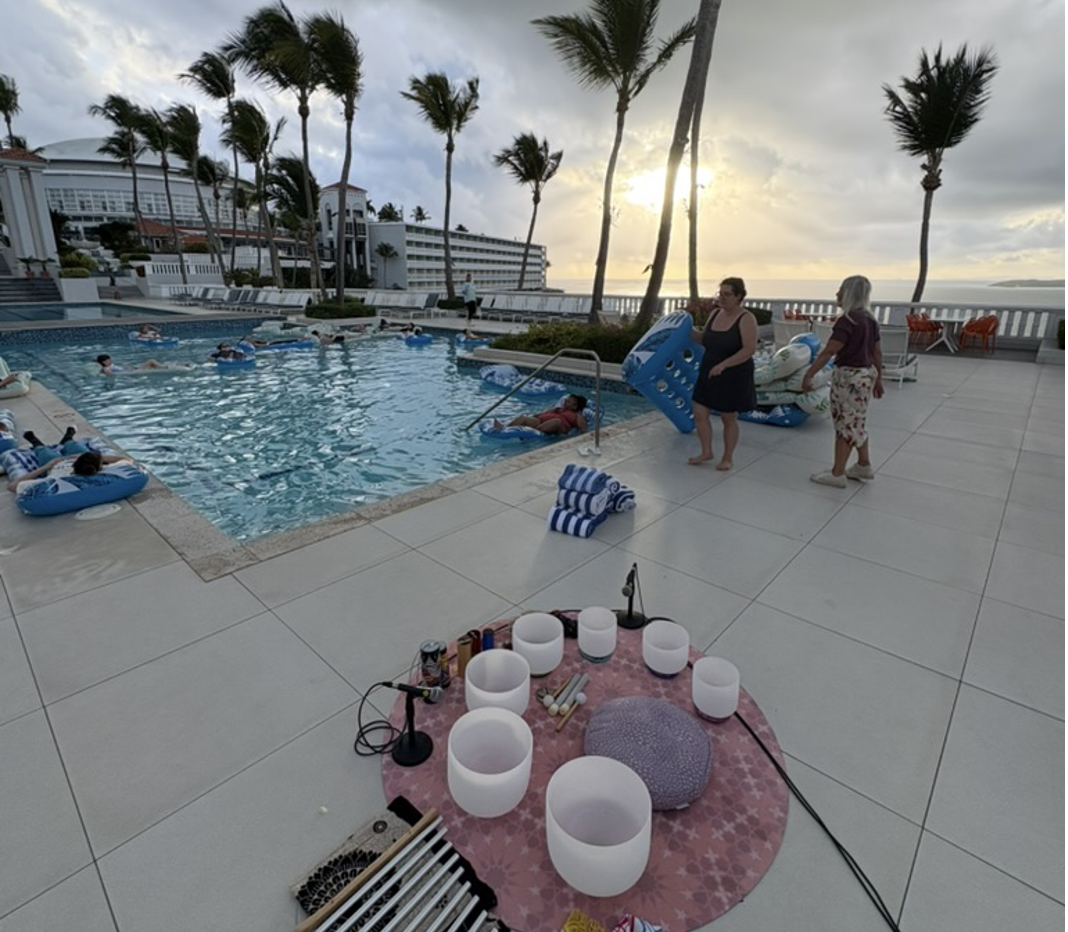
This morning, I was contracted by Santosha Yoga to facilitate a sound bath for a business conference at the Conquistador Hotel in Puerto Rico. As I sat down around the incredible south pool overlooking the ocean about to do a sound bath for professionals, entrepreneurs, executives, and business leaders, surrounded by crystal singing bowls, I found myself reflecting on how far this practice has come.
Historic background
Thousands of years ago, sound healing was used by shamans, spiritual leaders, monks, and healers. Today, it is being incorporated into leadership retreats, corporate wellness programs, professional conferences, and workplace well-being initiatives around the world.
What was once considered an ancient spiritual practice has found its way into boardrooms, convention centers, luxury resorts, and all sorts of retreats.
The question is: how did we get here?
The use of sound for healing dates back thousands of years. Ancient cultures recognized that sound and vibration had the ability to influence human emotions, mental states, and physical well-being. Indigenous communities used drums, rattles, chanting, and rhythmic sounds in healing ceremonies. In India, the practice of Nada Yoga—the Yoga of Sound—taught that all creation originates from vibration. Ancient Greeks, including the philosopher Pythagoras, studied the mathematical relationships between sound and harmony, believing music could restore balance to the body and mind.
Throughout history, sound was never viewed solely as entertainment. It was a tool for connection, transformation, and healing.
Over time, these traditions evolved. In the Himalayan regions of Nepal, Tibet, Bhutan, and Northern India, metal singing bowls became associated with meditation and contemplative practices. These bowls, crafted from bronze alloys, produce rich overtones and vibrations that can be both heard and physically felt. Modern practitioners often place these bowls directly on the body, allowing the vibrations to travel through muscles, tissues, and bones, creating a deeply grounding experience.
Fast forward
Fast forward to the late twentieth century, and a new instrument emerged: the quartz crystal singing bowl. Interestingly, these bowls do not have ancient origins. They were developed from quartz crucibles used in the semiconductor industry. When people discovered the pure, resonant tones these vessels could produce, they were adapted into musical instruments and eventually became staples of modern sound healing.
Today, crystal singing bowls are among the most recognizable instruments used in sound baths. Their sustained tones create immersive soundscapes that many participants describe as calming, meditative, and restorative.
What fascinates me most is not simply the history of these instruments, but how their use has expanded beyond traditional wellness settings.
In recent years, businesses have become increasingly aware of the impact stress has on productivity, creativity, decision-making, and employee retention. Leaders are recognizing that wellness is not a luxury—it is a business strategy.
As a result, companies are exploring new ways to support the mental and emotional well-being of their teams. Alongside mindfulness training, yoga, breath work, and meditation, sound healing has become another tool being integrated into workplace wellness programs.
I’ve facilitated sound experiences for entrepreneurs, leadership groups, retreat participants, educators, healthcare professionals, and corporate teams. What I’ve consistently observed is that people are craving opportunities to disconnect from constant stimulation and reconnect with themselves.
For many professionals, spending even thirty minutes immersed in sound provides something that is becoming increasingly rare: uninterrupted stillness.
The modern workplace moves quickly. Notifications never stop. Calendars stay full. Expectations continue to grow. Yet the human nervous system was not designed to operate in a constant state of activation.
Sound experiences create a space where participants can pause, breathe, and reset.
Whether someone approaches a sound bath from a spiritual perspective, a wellness perspective, or simply as a relaxation technique, the outcome is often similar: a feeling of calm, clarity, and renewed presence.
As I looked around this morning, I couldn’t help but appreciate the journey that brought sound healing to that moment. A practice rooted in ancient traditions was now supporting modern professionals as they navigated the challenges of leadership, business growth, and everyday life.
The instruments may have evolved. The settings may have changed. But the fundamental human need remains the same.
We all need moments to slow down, listen deeply, and reconnect with ourselves.
Perhaps that is why sound healing continues to grow; not because it is a trend, but because it offers something timeless in a world that rarely slows down.
Related content:
Harmonizing Health, The Power of Sound Healing [Video]
Using Conscious Music to Elevates Latino Entrepreneurs
Why Self-Care and Travel Are Essential for Sustainable Success